
Woodridge Deck & Gazebo Co. has updated the design guidance it provides to property owners following a July heat event in which overnight conditions, rather than daytime highs, proved the more difficult factor for outdoor spaces. The company, a TimberTech Platinum contractor and Deckorators Certified Elite installer, now weights evening ventilation alongside daytime sun control when specifying covered structures.
The revision follows documented conditions across the region. Illinois State Climatologist Trent Ford reported that during the first week of July 2026, high temperatures reached the mid-90s with heat index values climbing past 100, and identified the persistent humidity and warm nights as the more remarkable feature of the event rather than the afternoon peaks. Ford noted that Chicago recorded more than 60 consecutive hours with heat index values above 80 degrees. The atmospheric ridge responsible for the heat also suppressed rainfall through the same period, leaving surfaces dry as well as warm.
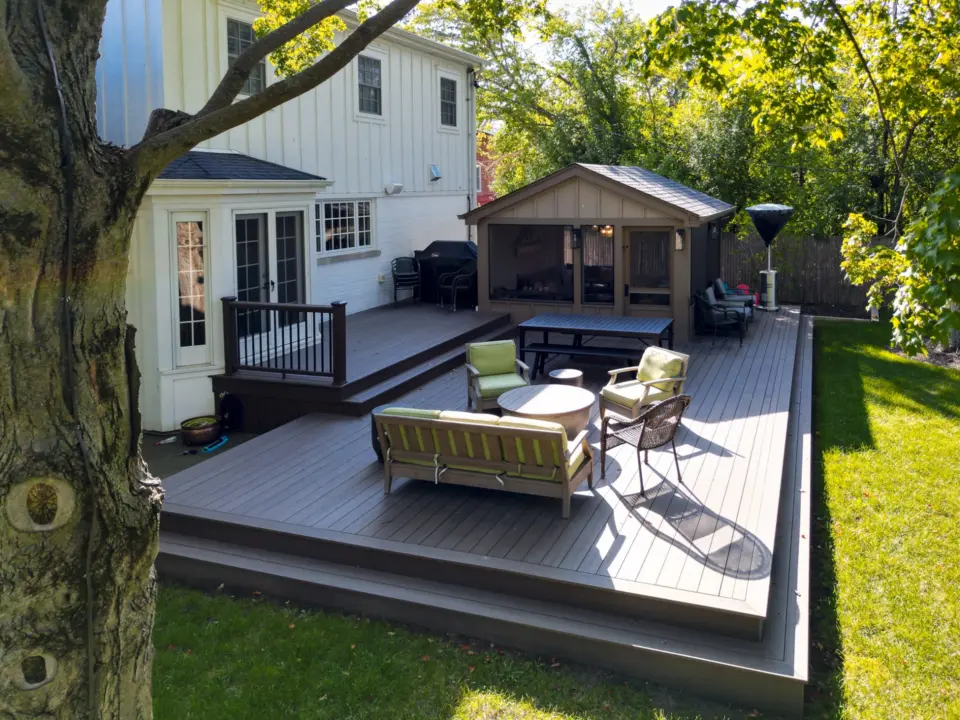
Regional climate data provides additional context for why the effect is felt unevenly across the metropolitan area. The Illinois State Water Survey documents that urban areas across northeastern Illinois average roughly two degrees warmer than surrounding rural land, with the difference most pronounced overnight, when built surfaces release heat absorbed during the day. The same source describes the moderating influence of Lake Michigan on communities near the shoreline, where lake breezes provide relief from summer heat that does not extend as reliably to areas further inland. Communities across the northwest suburbs sit far enough from the lake that they receive less of that moderating effect.
Longer-term records indicate the pattern is not isolated to a single season. The Illinois State Water Survey reports that summer has accounted for most of the increase in precipitation across northern and central Illinois, and that the frequency of very hot days in northern Illinois is projected to rise substantially over the coming decades. Warm nights are among the changes documented alongside the daytime figures that receive more attention.
The practical consequence for outdoor structures is a matter of timing rather than tolerance. Materials that absorb heat through the day release it more slowly when air temperatures remain elevated after sunset. That affects when a covered space becomes comfortable in the evening rather than whether it does at all. A structure that can be opened after dark ventilates differently from one that remains closed, and that difference is more noticeable during a stretch of consecutive warm nights than during an isolated hot afternoon.
"For most of the years we have been building, shade was a question in the middle of the afternoon," said Eric Hoffman, owner of Woodridge Deck & Gazebo Co. "What we saw in July was different. The daytime numbers were high, but the nights were what people noticed. If a structure cannot open up after dark, the space stays warm longer than the weather alone would explain."
The updated guidance centers on adjustable and openable systems. Louvered pergolas with operable louvers, whether motorized or manually adjusted, allow a covered area to be closed against direct sun during peak hours and opened after sunset once the angle of the sun is no longer the governing factor. Screen rooms and screened porches occupy a position between open-air and fully enclosed construction, retaining airflow while providing a barrier. Retractable systems allow coverage to be deployed during a heat event and withdrawn when conditions moderate, which suits a climate where individual weeks vary considerably.
Fixed-roof structures remain appropriate where continuous overhead protection is the objective, and the company continues to build pavilions, covered porches, and permanent patio covers for that purpose. In those cases the evaluation shifts to how the sides of the structure are treated, since openable or screened sides change how air moves beneath a permanent roof. Orientation matters as well, because the direction a structure faces determines which hours of direct sun it receives and how quickly the surrounding surfaces shed accumulated heat once the sun drops.
The company reports that the change has affected the design stage more than the construction stage. Layout, orientation, and the choice between fixed and adjustable overhead systems are settled during planning, when 3D renderings and floor plans are produced, rather than after a structure is standing.
"The question we ask now is what the structure does at nine at night, not just at two in the afternoon," Hoffman said. "That is a different conversation than the one we were having ten years ago, and it changes which system fits a particular property."
Woodridge Deck & Gazebo Co. is a family-owned builder of custom decks, gazebos, pergolas, pavilions, porches, and sunrooms serving communities across the Chicago area. The company is a TimberTech Platinum contractor and a Deckorators Certified Elite installer, handles local permitting in-house, and maintains a showroom where property owners can view and select materials.
###
For more information about Woodridge Deck & Gazebo Co., contact the company here:
Woodridge Deck & Gazebo Co.
Cristina B
+18472500086
chicagocristy@gmail.com
2246 Palmer Dr #101, Schaumburg, IL 60173, United States