
Mr. Dent Collision Repair has published a new consumer guide explaining the factors technicians may consider when evaluating dents before determining whether paintless dent repair is an appropriate repair method.
The September resource expands the company's existing paintless dent repair information with a more specific explanation of the evaluation that takes place before a repair approach is selected. The guide focuses on four areas: paint condition, dent characteristics, access to the affected area, and construction of the damaged component.
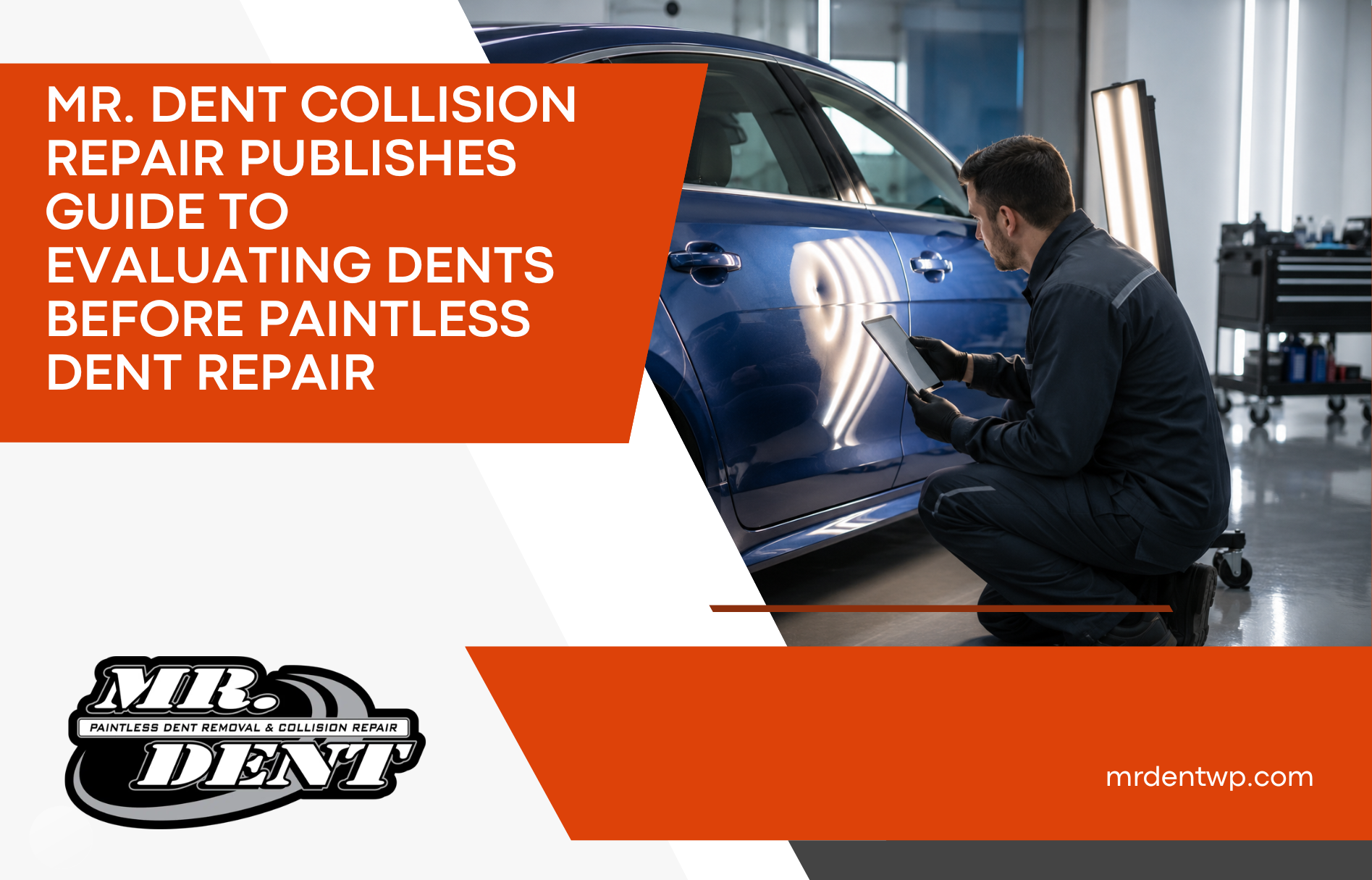
Mr. Dent Collision Repair developed the guide for consumers served by its Ozark facility at 2116 N 20th St, Ozark, MO 65721. The new material is intended to help vehicle owners understand why the visible size of a dent alone does not determine whether paintless dent repair, commonly known as PDR, is suitable.
Paintless dent repair is a repair method used to reshape qualifying dents while retaining the existing painted finish. Depending on the location and characteristics of the damage, technicians may use specialized tools and techniques to work with the affected portion of a panel without conventional refinishing.
The first area covered in the new guide is paint condition. Because PDR is intended to retain the existing finish, the condition of that finish provides important information during the initial evaluation.
A dent with an intact painted surface can present different repair considerations from damage involving cracked, chipped, separated, or otherwise compromised paint. The guide does not suggest that intact paint automatically makes a dent suitable for PDR. Instead, paint condition represents one of several factors evaluated together.
Dent characteristics form the second part of the framework. Shape, depth, location, and the way the affected area has changed can all contribute information about the condition of the panel.
For example, a broad dent in an open portion of a panel presents different considerations from damage involving a sharp crease, panel edge, body line, attachment area, or another location with more complex geometry. The apparent diameter of the dent therefore provides only part of the information used during evaluation.
The September publication specifically adds this distinction to help consumers avoid treating dent size as a simple qualification standard. Two dents that appear similar from a distance may involve different panel locations, materials, paint conditions, or access considerations.
Access to the damaged area is the third subject addressed in the guide. Some paintless dent repair techniques require technicians to reach or otherwise work with particular portions of the affected panel. Vehicle construction can influence whether that access is available and what preparation may be necessary before the area can be evaluated or repaired.
Interior trim, braces, reinforcements, adjacent components, and other construction features can affect access. In some situations, components may need to be removed before technicians can more completely evaluate the affected area.
The guide distinguishes accessibility from repairability. Limited initial access does not automatically establish that PDR cannot be performed, just as accessible damage does not automatically establish that paintless repair is appropriate. Accessibility is one element considered alongside the other documented conditions.
Panel construction is the fourth area included in the September resource. Modern vehicle exteriors can incorporate steel, aluminum, plastics, composites, and other materials depending on the vehicle and component.
Because construction can differ between vehicles and even between components on the same vehicle, the guide explains why technicians identify the affected panel rather than assuming the same technique applies to visually similar dents.
The updated information also addresses the importance of vehicle-specific repair research. Depending on the component involved, manufacturer information may provide procedures, limitations, or other technical information relevant to the work being considered.
Mr. Dent Collision Repair therefore presents its four-part framework as consumer education rather than a universal PDR qualification standard. The appropriate repair approach depends on the actual vehicle, affected component, documented damage, and applicable repair information.
Hail damage provides a useful example of how these factors can vary within one vehicle. A hail event can leave dents across a hood, roof, doors, fenders, deck lid, or other exposed surfaces. Although those dents may have resulted from the same event, their characteristics and the construction of the affected areas may differ.
One panel may have accessible dents and an intact finish, while another area can present different geometry, access, material, or paint conditions. The guide explains why technicians can evaluate individual affected areas rather than assuming that every dent on a hail-damaged vehicle will require the same procedure.
Door dings and other localized dents provide another example. The fact that a dent resulted from a parking-lot incident, door contact, or another relatively localized impact does not by itself determine the repair method. Evaluation of the affected area provides the information needed for repair planning.
The guide also clarifies what happens when PDR is not selected. A dent that does not meet the conditions for paintless repair is not automatically assigned one specific alternative procedure. Conventional auto body repair, component replacement, or refinishing may be considered when applicable, depending on the documented condition and repair information for the vehicle.
This distinction is a central addition to the September publication. Rather than categorizing dents as simply suitable or unsuitable based on appearance, the guide explains the evaluation that precedes selection of a repair method.
The new resource also gives consumers a concise sequence they can use when reviewing a dent evaluation. Paint condition establishes whether the existing finish has been affected. Dent characteristics describe the physical condition of the damaged area. Accessibility identifies considerations associated with reaching the panel. Component construction provides vehicle-specific context for the repair research.
Taken together, those four areas provide a more complete explanation of why two apparently similar dents can lead to different repair plans without suggesting that any one characteristic automatically determines the outcome.
The publication adds this evaluation-focused material to Mr. Dent Collision Repair's existing consumer information because PDR is often described primarily in terms of what the technique does. The September guide instead concentrates on the information technicians consider before determining whether the technique applies.
That narrower focus gives vehicle owners a reference for understanding why an evaluation precedes a PDR recommendation and what distinctions can be relevant during that process. It does not predict the repair required for an individual vehicle before the affected area has been inspected.
The new consumer guide is available through Mr. Dent Collision Repair's paintless dent repair resource. Consumers can also review examples of the company's completed repair work through the See Our Work section of its website.
Additional information about the Ozark facility is available through the Mr. Dent Collision Repair location page.
About Mr. Dent Collision Repair
Mr. Dent Collision Repair serves vehicle owners in Ozark, Missouri, and surrounding communities from its facility at 2116 N 20th St, Ozark, MO 65721. The company provides collision repair, auto body repair, paintless dent repair, auto glass repair, OEM-certified repair services, and related vehicle restoration services. Additional information about the company and its history is available through the Mr. Dent Collision Repair About page.
###
For more information about Mr. Dent Collision Repair, contact the company here:
Mr. Dent Collision Repair
Logan Martin
417-581-5103
logan@mrdentmo.com
2116 N 20th St, Ozark, MO 65721, United States