
Mr. Dent Collision Repair has published new consumer guidance introducing a three-part framework for evaluating collision damage concentrated around a vehicle’s wheel openings. The October resource focuses specifically on separating visible exterior damage from conditions that require additional inspection, giving vehicle owners a clearer explanation of how technicians can evaluate fenders, quarter panels, concealed components, attachment areas, and adjoining body sections after an impact.
The publication adds a more narrowly defined wheel-area evaluation framework to Mr. Dent Collision Repair’s existing collision repair information. Rather than treating damage near a wheel as a single condition, the guidance organizes evaluation into three categories: the visible wheel opening and exterior panels, components concealed behind those panels, and the attachment areas connecting the damaged section with neighboring parts of the vehicle.
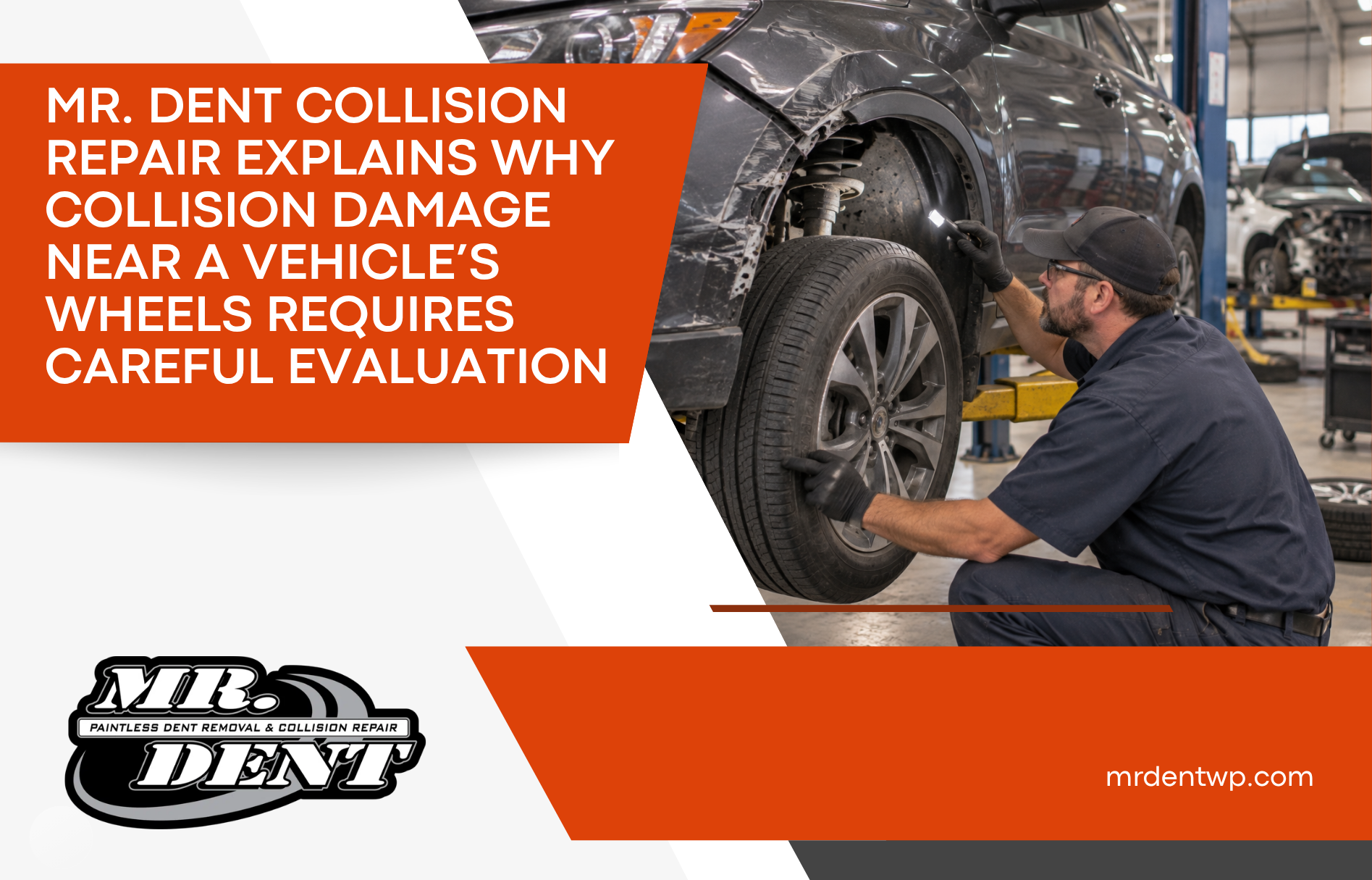
The first category covers the wheel opening and surrounding exterior surfaces. Front wheel openings are commonly bordered by fenders and adjoining bumper components, while rear openings can form part of quarter panels or other body assemblies. A collision can dent or deform these components, alter the shape of the opening, or move an exterior edge closer to the tire.
Clearance is one reason the location of this damage matters. Body components surrounding a wheel must maintain appropriate relationships with the tire as the vehicle travels and turns. A panel displaced toward the tire can create evidence of rubbing or contact that was not present before the collision.
Those observations help establish where technicians should focus the assessment, but they do not establish the condition of the suspension, steering system, or other mechanical components. A damaged fender or quarter panel can remain primarily a body repair issue when physical evidence does not support a broader conclusion.
The second category addresses components located behind the visible exterior surface. Depending on the vehicle, wheel-opening areas can contain liners, brackets, shields, fasteners, wiring, mounting points, and other components that are partially or completely concealed during an exterior inspection.
I-CAR, a nonprofit organization providing collision repair education and technical information, emphasizes the importance of thorough damage analysis and appropriate disassembly when needed to identify collision-related conditions that cannot be adequately evaluated while damaged components remain assembled. Its repair-planning resources describe damage analysis as a process that can include disassembly, documentation, vehicle measurement, OEM repair research, and identification of required repair operations.
That principle is particularly relevant around wheel openings because several components can occupy a relatively small area. A wheelhouse liner, for example, may be attached around portions of a fender, bumper, or surrounding body structure. Collision-related displacement can affect the liner or its attachment points even when the exterior panel remains the most obvious damaged component.
Gaining access to the area allows technicians to distinguish confirmed conditions from assumptions. An exterior impact does not automatically mean that everything behind the panel has been damaged. Instead, appropriate inspection can identify which components remain unaffected and which require inclusion in the repair plan.
Modern vehicle equipment adds another consideration. Wiring, electrical connectors, sensors, and other equipment can be located around bumpers, fenders, and adjoining areas depending on the individual vehicle. Their presence and repair relevance are determined by the vehicle configuration and the location of the documented damage rather than by a general assumption about wheel-area collisions.
The third category introduced in the October guidance addresses attachment areas and adjoining body components. Fenders, quarter panels, and bumper sections interact with other portions of the vehicle rather than functioning as isolated exterior surfaces.
A front fender can meet a bumper, hood area, door, rocker area, wheelhouse, and other components. A rear quarter panel can relate to the rear bumper, door or body opening, rocker area, wheelhouse, and additional sections depending on vehicle design.
Collision forces can change these relationships. Technicians may observe altered panel gaps, displaced mounting locations, damaged fasteners, distorted edges, or changes in the way adjoining components fit together.
Mr. Dent Collision Repair’s auto body repair information provides additional context for determining how confirmed exterior body damage is addressed. Repair planning can consider component condition, construction, accessibility, damage characteristics, attachment methods, and applicable manufacturer procedures before a repair or replacement decision is made.
The October publication identifies this distinction as a key reason wheel-area damage deserves component-by-component evaluation. A dent visible on the outside of a fender can be evaluated separately from the liner behind it, the mounting points supporting it, and the neighboring bumper or door.
The same principle applies to rear quarter-panel damage. The visible exterior surface provides important information, but technicians can also consider the wheel opening, attachment areas, adjoining components, and accessible portions behind the damaged section when those areas are relevant to the impact.
Vehicle-specific repair information provides another technical reference point. I-CAR advises collision repair professionals to consult OEM repair procedures because vehicle makers can specify different materials, joining methods, repair limitations, corrosion-protection requirements, and replacement procedures for body components.
This becomes significant because similar-looking collision damage can require different repair approaches on different vehicles. A technician cannot determine the complete procedure solely from the appearance of a dent or the general name of the damaged panel.
The make, model, model year, component construction, and manufacturer information can influence how the confirmed damage is addressed.
The October guidance also draws a deliberate distinction between body damage near a wheel and a mechanical diagnosis. Some collisions can affect wheels, tires, steering, suspension components, or their mounting areas, particularly when direct wheel contact occurs. However, exterior damage located near a wheel does not by itself prove that those systems were damaged.
I-CAR technical guidance similarly treats steering and suspension inspection as a distinct part of collision damage analysis when the impact conditions or physical evidence make those systems relevant. This supports evaluating the evidence associated with the individual accident rather than automatically assigning a mechanical condition based solely on the location of an exterior dent.
That distinction is intended to make the new resource more useful for consumers reviewing a repair plan. A wheel-area collision can result in several separate findings, and each finding should correspond with an observed condition or applicable repair procedure.
A damaged exterior panel may require body repair. A displaced liner may require separate attention. A damaged mounting point may affect how adjoining components are restored. Mechanical evaluation can become relevant when direct impact or other evidence supports it.
Separating those findings provides more useful information than treating the entire wheel area as one undifferentiated repair.
The October guidance also explains the role of access during repair planning. Certain areas can be evaluated from the exterior, while others may require removal of damaged trim, liners, bumper components, or other obstructing parts before their condition can be documented.
This does not mean disassembly should be interpreted as evidence that additional damage has already been found. Its purpose is to make relevant areas accessible enough to determine their actual condition.
That distinction also helps consumers understand why the repair plan can contain operations that are not obvious from photographs of the exterior damage. Collision repair can involve gaining access, inspecting attachment points, researching manufacturer procedures, restoring affected factory-applied materials, and reassembling components after the physical body repair has been completed.
Corrosion protection can be relevant when repair operations disturb factory-protected areas. I-CAR technical resources address the restoration of corrosion protection during collision repair and emphasize following vehicle-maker information and product procedures where applicable. The specific materials and restoration steps depend on the vehicle and the repair being performed.
These technical considerations do not mean every wheel-area collision becomes an extensive repair. The October publication specifically limits its framework to determining what the individual collision actually affected.
A noticeable fender dent may remain limited to the fender and associated refinishing operations. Another impact in a similar location may affect an attachment point or concealed component. The exterior appearance alone cannot establish that the two vehicles require identical repair plans.
This is the principal consumer-education point added by the October publication. The new three-part framework gives drivers a defined way to understand the assessment rather than relying on the broad concept of hidden damage.
The visible wheel opening and exterior panel establish the first area. Accessible components behind the exterior surface form the second. Attachment points and adjoining body sections form the third. Findings from those areas can then be documented individually and addressed according to their actual condition and applicable vehicle procedures.
The framework also provides a clearer distinction between evaluation and diagnosis. Changes in panel fit, clearance, component position, or attachment condition can identify areas that deserve attention, but technicians still determine the repair scope from documented findings.
This approach avoids two opposite assumptions: that visible wheel-area damage is purely cosmetic in every case, or that a dent near a wheel automatically means significant concealed or mechanical damage has occurred.
The October guidance is therefore narrower than Mr. Dent Collision Repair’s broader information about collision and auto body repair. Its new contribution is a component-based framework specifically for accidents concentrated around wheel openings, providing consumers with a clearer explanation of how visible panels, concealed components, and attachment areas can be evaluated separately during repair planning.
Additional information about Mr. Dent Collision Repair and its repair approach is available through the company’s About Us page.
Mr. Dent Collision Repair provides collision repair, auto body repair, paintless dent repair, and related vehicle repair services for drivers in Southwest Missouri. The company’s repair-planning approach centers on documenting the conditions associated with the individual collision and applying relevant repair information to the affected vehicle.
###
For more information about Mr. Dent Collision Repair, contact the company here:
Mr. Dent Collision Repair
Logan Martin
417-581-5103
logan@mrdentmo.com
2116 N 20th St, Ozark, MO 65721, United States