
KoreInside Says SEC Innovation Exemption Reinforces Permissioned Access as a Foundation for Tokenized Securities Markets
NEW YORK, NY – September 21, 2026 – (KOREWIRE) — KoreInside today welcomed the U.S. Securities and Exchange Commission’s new Innovation Exemption as an important step toward bringing regulated securities markets onchain while preserving the identity, permissioning, investor protection, and market-integrity controls required of securities markets.
Announced September 17, 2026, the SEC’s temporary, conditional framework enables certain Tokenized Securities Venues (TSVs) to facilitate trading in tokenized NMS stocks using Automated Market Makers (AMMs), while requiring permissioned access to those markets. The framework also requires the relevant TSV smart contracts to be public and auditable and deployed on a public, permissionless distributed ledger.
For KoreInside, the significance lies in the SEC’s combination of two principles that are often incorrectly treated as alternatives: open blockchain interoperability and permissioned securities activity.
KoreInside has spent years developing infrastructure based on the principle that a security may move across different technology environments, but the identity, compliance, ownership, and authorization rules governing that security must remain intact wherever the transaction occurs.
“The conversation around blockchain has too often been framed as permissioned versus permissionless. Regulated capital markets need the advantages of both,” said Oscar A. Jofre, Co-Founder and CEO of KoreInside. “Public blockchain ecosystems can provide reach, interoperability, and new forms of market access. But securities transactions still require verified participants, defined rights, regulatory controls, and accountable infrastructure. The SEC’s Innovation Exemption recognizes that permissioned access remains essential even as securities markets move onchain. That is the architecture KoreInside has been building from the beginning.”
KoreChain as the Permissioned Control Layer
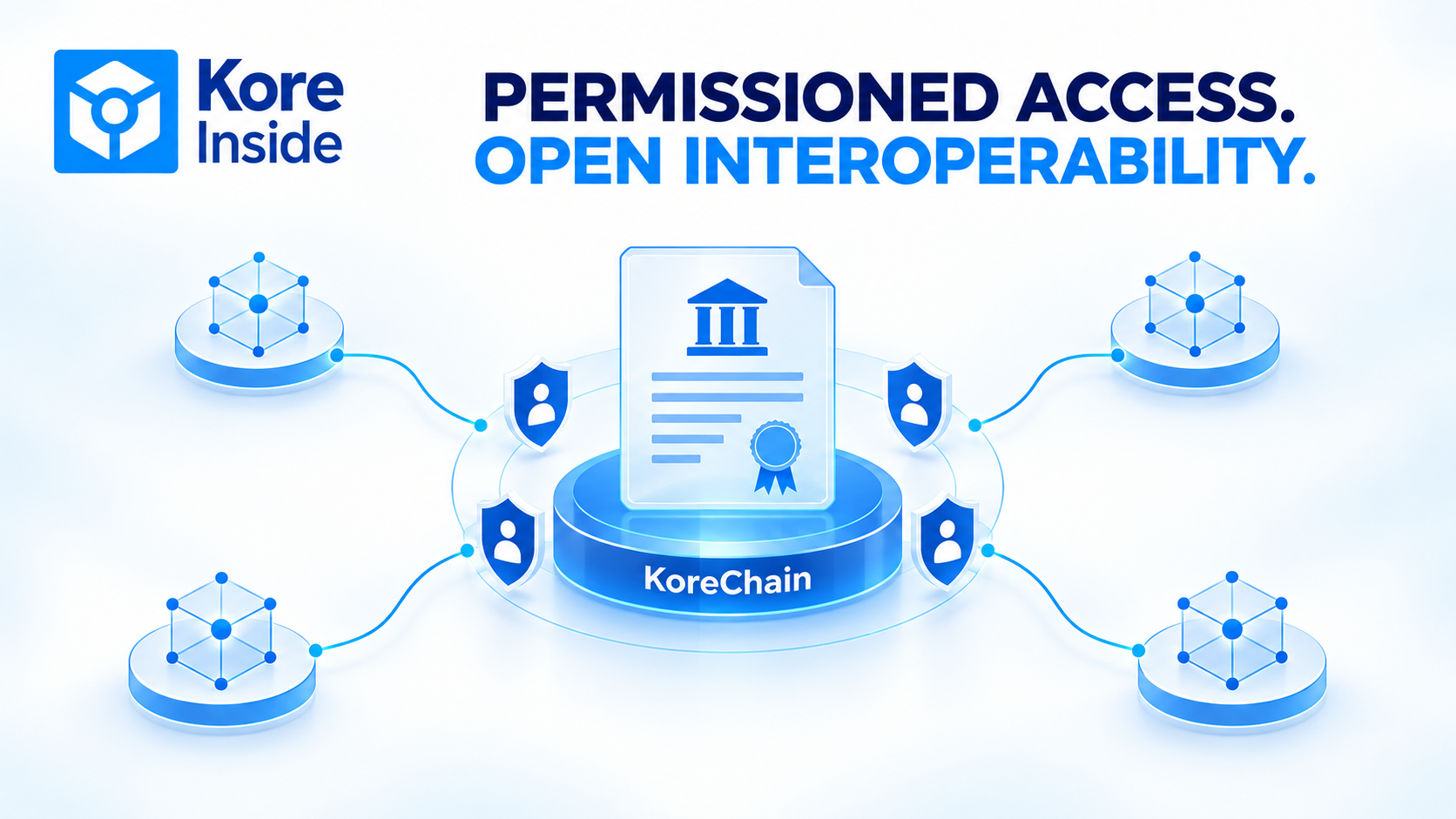
At the center of KoreInside’s digital securities architecture is KoreChain, a permissioned blockchain infrastructure for regulated capital markets. KoreChain is designed around authenticated participants, regulated intermediaries, compliance-controlled transactions, immutable records, and deterministic securities lifecycle management. KoreInside’s architecture separates the question of where a transaction executes from the question of whether that transaction is authorized. The latter remains governed by the regulatory state of the security and its participants.
Through KoreID, KoreInside can maintain verified participant identity, eligibility, wallet association, KYC/AML and sanctions status, and other required attributes. Through KoreToken and KoreInside’s compliance infrastructure, transaction rules can incorporate securities ownership, transfer restrictions, issuer requirements, regulatory conditions, transfer-agent controls, freezes, corporate actions, and other security-specific constraints.
This allows KoreChain to operate as a persistent permissioned trust and authorization layer even when a security is represented or transacted elsewhere.
Twin Technology Connects KoreChain to Public Blockchains
KoreInside’s Twin technology was designed specifically for a multi-chain capital markets environment.
A security can have a canonical KoreToken that exists within the permissioned KoreChain environment while a corresponding execution representation can be deployed on a public blockchain such as Ethereum, Solana, Base, or another compatible ecosystem.
The public-chain representation is not intended to become an independent security operating outside the regulatory framework. It remains connected to its KoreToken twin and to the compliance and authorization infrastructure governing the underlying security.
The result is an architecture in which a security can gain the interoperability and ecosystem access of public blockchains while retaining a common regulatory control point.
“A security should be able to move across technology ecosystems without its compliance becoming fragmented across those ecosystems,” said Dr. Kiran K. Garimella, Co-Founder, Chief Scientist, and CTO of KoreInside. “The public-chain token provides the execution representation appropriate for that blockchain, while the KoreToken on KoreChain remains the canonical regulatory twin. A proposed transaction can be checked in real time against identity, ownership, eligibility, transfer restrictions, and the current regulatory state before it is authorized. Ethereum does not need to know what happened on Solana, and Solana does not need to know what happened through an ATS or an API. KoreToken can maintain the common securities state across all of them.”
This architecture is designed to support transactions across public and permissioned blockchains as well as conventional capital-markets systems connected through APIs. Public blockchain infrastructure can remain open and auditable while participation in the securities market remains permissioned. Twin also addresses chain fragmentation by binding external execution representations to a common KoreToken and regulatory state, so the same security can interact with multiple venues and ecosystems without creating independent compliance silos.
Infrastructure for the Emerging Onchain Capital Market
KoreInside sees the SEC initiative as an important opportunity for public tokenized securities and, over time, for the evolution of private capital markets. The company’s infrastructure spans KoreID, KoreChain, KoreTransfer, KorePay, and emerging KoreClearing capabilities, providing a common identity, compliance, ownership, and authorization framework across execution environments.
KoreInside’s strategy is therefore not dependent on one blockchain becoming dominant. The company is building infrastructure intended to let regulated securities interact with multiple chains and venues while preserving a persistent regulatory and ownership framework.
“The future of capital markets will not be one chain, one venue, or one technology,” Jofre added. “The opportunity is to create the infrastructure that allows all of them to interoperate without losing the protections and accountability that make a securities market trustworthy. That is where KoreInside intends to be.”
About KoreInside
KoreInside provides integrated technology infrastructure for the private capital markets, supporting issuers, broker-dealers, transfer agents, alternative trading systems, investment professionals, financial institutions, and investors across the securities lifecycle. Its infrastructure brings together identity, compliance, capital formation, payments, securities recordkeeping, blockchain, distribution, secondary-market connectivity, and post-trade capabilities in a white-label, API-first environment.
KoreChain is KoreInside’s permissioned blockchain infrastructure for regulated securities and capital-markets activity. KoreInside’s Twin technology extends that architecture across public and other blockchain ecosystems while maintaining a common regulatory and authorization framework.
KoreInside provides technology infrastructure to regulated market participants and does not offer, recommend, or solicit securities.
About KoreInside
KoreInside is a global capital markets infrastructure company providing blockchain technology, digital securities solutions, identity management, compliance automation, transfer agency services, and regulatory technology for private capital markets. Through its ecosystem, including KoreChain, KoreOracle, KoreID, Compliance Desk, and KoreTransfer, KoreInside enables the compliant digitization, issuance, management, and transfer of securities across global markets.
For more information, visit www.koreinside.com or www.koreid.app.
Media Contact
KoreInside
Email: danielle@kore.inc
Website: www.kore.inc
Website: www.koreinside.com
SOURCE: KoreInside