
A series of Indian labour and payroll regulations taking effect through 2026 is changing how United Kingdom companies manage staff employed in India through employer-of-record arrangements. The changes include a revised Employees' Provident Fund scheme, a new tax reporting form, and expanded gratuity eligibility for employees on fixed-term contracts.
Under India's 2025 and 2026 Labour Codes, a new Employees' Provident Fund scheme takes effect June 29, 2026, capping the mandatory employer contribution at 1,800 rupees per employee. Separately, a new Form 130 will replace the long-used Form 16 for tax deducted at source reporting starting April 1, 2026. Employees on fixed-term contracts will also become eligible for gratuity payments after one year of service, a reduction from the previous five-year threshold.
An employer of record is a third-party organization that serves as the legal employer for staff in a foreign country, handling payroll administration and statutory compliance, while the hiring company directs the employee's day-to-day work. UK companies have used the structure to establish a working presence in India without forming a local subsidiary, a process that typically takes three to six months, compared with roughly two to seven days under an employer-of-record arrangement. Background on the structure is available at ansr.com/employer-of-record.
Employer-of-record providers typically charge UK clients between £75 and £530 per employee each month, depending on the scope of services, according to industry pricing data. Statutory costs layered on top include a 12 percent provident fund contribution, a 4.81 percent gratuity accrual, and, for employees earning less than 21,000 rupees monthly, a 25 percent contribution under the Employees' State Insurance scheme. Professional tax, a state-level levy, is capped at 2,500 rupees annually under constitutional limits. The Employees' State Insurance contribution no longer applies once an employee's wages exceed the threshold, a distinction that affects total compliance costs as UK employers scale teams in India.
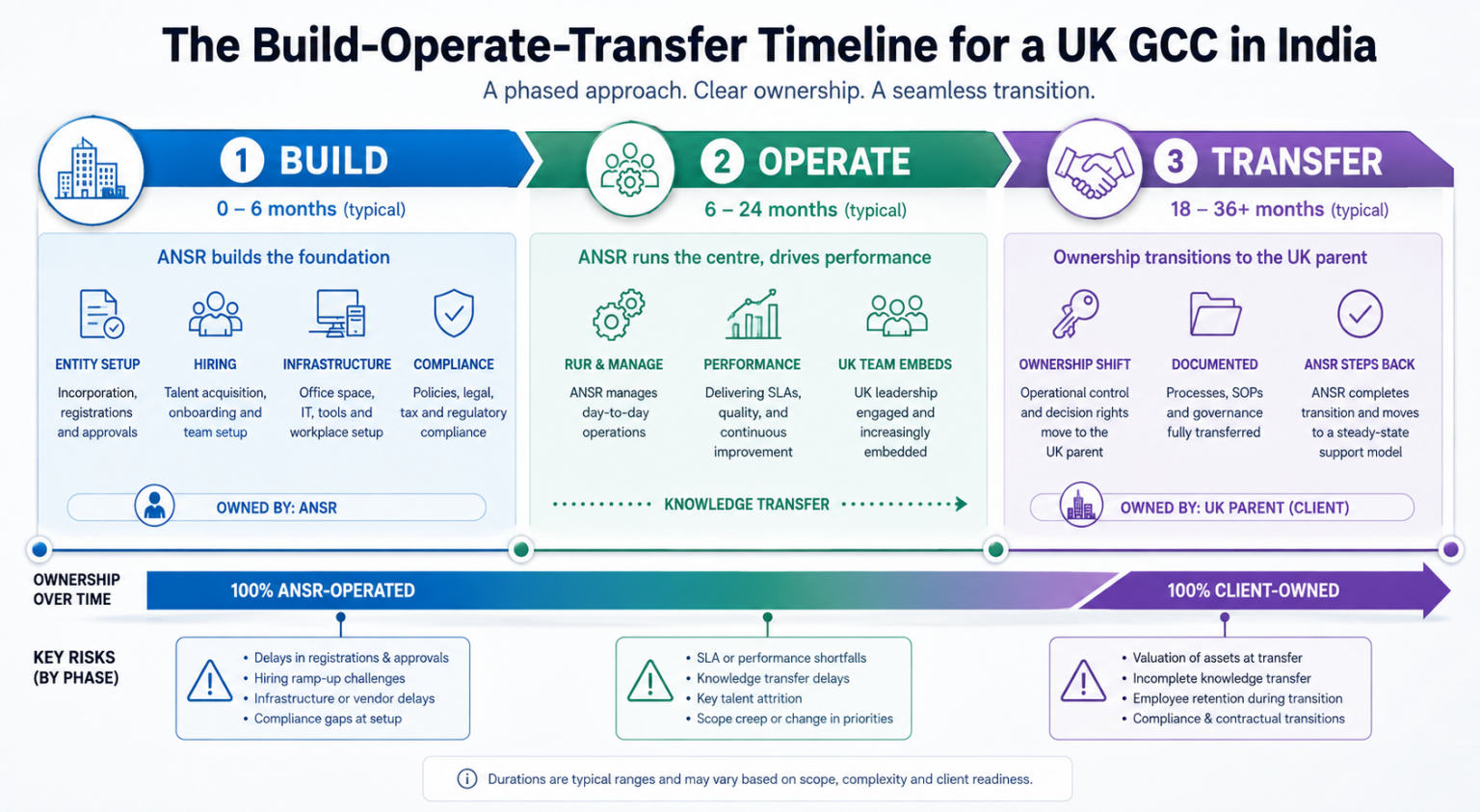
Some UK companies eventually transition from an employer-of-record structure to a wholly owned Indian entity. Industry data suggests this shift is typically considered once a team grows beyond 25 to 100 employees, or when intellectual property ownership becomes a priority for the business. Teams of five to ten employees are generally viewed as too small to support the strategic integration associated with a fully owned global capability center.
https://youtu.be/B5wOZC8mfis
Further analysis of the changes is available in ANSR's detailed guide.
About ANSR
ANSR is the definitive global leader in establishing and operating Global Capability Centers. With over 225 GCCs built, more than 250,000 employees hired, and over 14 million sq. ft. of workspace managed, ANSR combines strategic insight, proven execution capabilities, and proprietary technology solutions to help enterprises build and grow their global teams. As pioneers of the GCC as a Service model and creators of the 1Wrk™ platform, ANSR continues to redefine how enterprises achieve operational excellence and accelerate their digital transformation journeys. With deep GCC expertise, a strong talent ecosystem, and an integrated platform-led model, ANSR delivers predictable outcomes that enable enterprises to gain competitive advantage through their global capability centers. To learn more, visit ansr.com.
###
For more information about ANSR Global Corporation Private Limited, contact the company here:
ANSR Global
Clint Thomas
+919739097351
Clint.Thomas@ansr.com
Ground and 3rd Floor, L1, Banyan Block, Manyata Embassy Business Park SEZ, Nagawara Outer Ring Road, Bengaluru 560 045